
LESS and ADA put crisis management teams to the test at University of Inland Norway
The storm "Grete," 15,000 Allied soldiers, and three municipal crisis management teams: LESS and ADA Resilience supported a crisis management exercise at Inland Norway University of Applied Sciences.
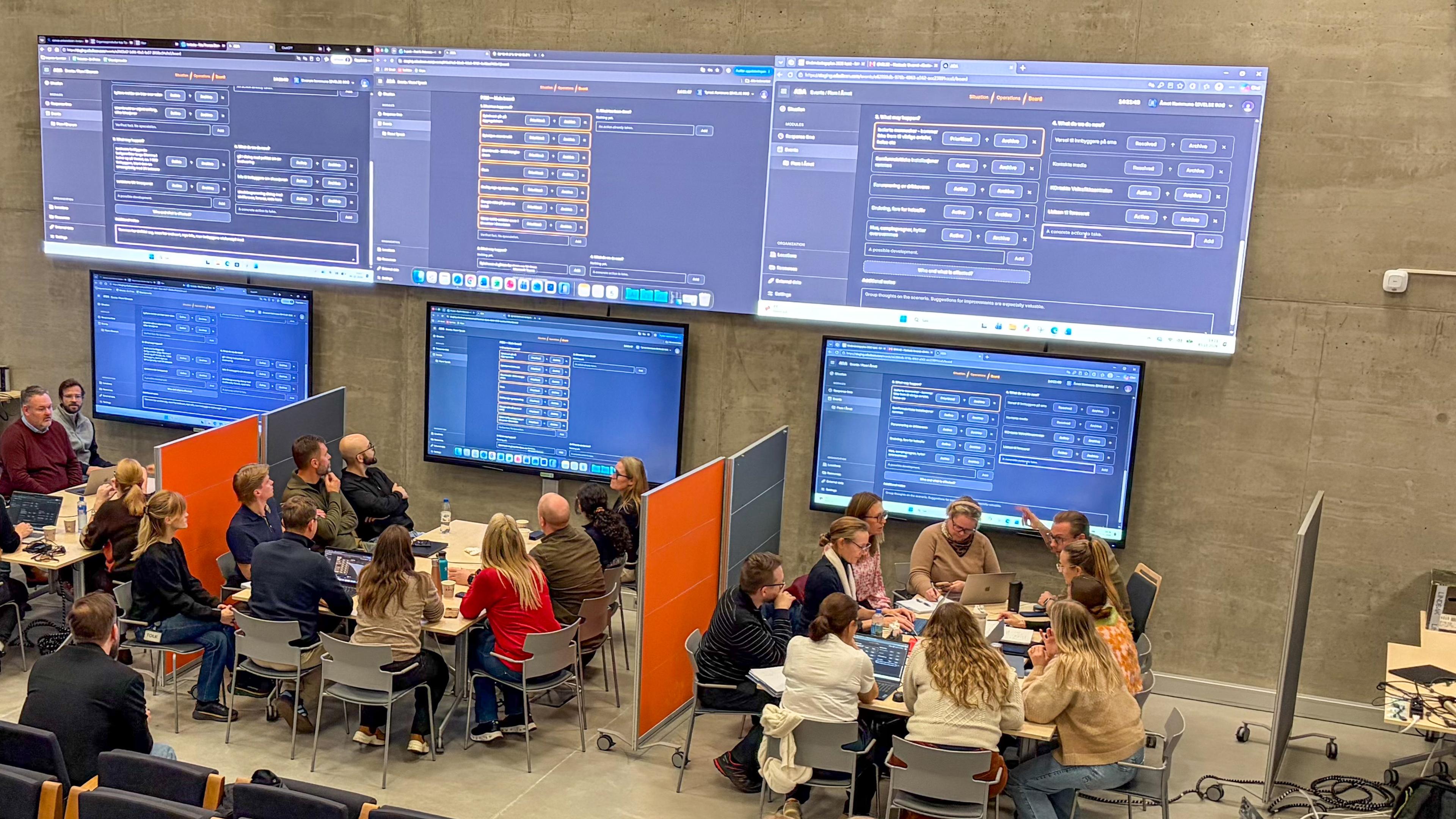
On Thursday, November 5, students enrolled in the course MPAR4007 at Inland Norway University of Applied Sciences (INN) conducted Exercise "OFSE"—a map-based tabletop exercise focused on municipal and regional crisis management. LESS AS and ADA Resilience supported the execution of the exercise, in collaboration with the PROTECT emergency preparedness center at INN.
The scenario was set for April 2, 2026. The storm "Grete" strikes the Innlandet region, bringing heavy precipitation, winds of 15–20 m/s, and snowmelt. County roads 29 and 219, along with smaller roads crossing the Hedmarksvidda plateau, are closed, and the County Governor of Innlandet has instructed the municipalities to activate their crisis management teams.
Simultaneously, approximately 15,000 Allied soldiers participating in the NATO exercise "Polar Fronts 2026" are bivouacked between Tynset and Rena, awaiting transport further south. The Norwegian Home Guard is assisting the police with traffic control.
Three municipalities – one region
The students were divided into three groups, each acting as the crisis management team for one of the municipalities: Elverum, Åmot, or Tynset. Following an initial joint briefing, the groups were tasked with developing a shared situational awareness, prioritizing short-, medium-, and long-term consequences, and establishing a plan for meetings, status updates, and media relations—all in accordance with proactive staff methodology.
Throughout the exercise, the response cell provided continuous updates, including information regarding power outages, road closures, and the need for evacuations. The exercise concluded with a press briefing involving all three municipalities.
Digital situational awareness and a realistic response cell
The crisis management teams used the decision-support tool ADA for maintaining a situational overview, logging, and coordination. The exercise control team—comprising the exercise management (Excon/“Game Master”) and a response cell—was staffed by personnel from LESS, ADA Resilience, and PROTECT. The response cell role-played the various entities the municipalities had to interact with: the County Governor, emergency services, the Norwegian Water Resources and Energy Directorate (NVE), the Civil Defence, the Armed Forces and the Home Guard, voluntary organizations, and the media.
In the lead-up to the event, LESS also assisted in tailoring the scenario and developing the “script”—the sequence of events and inputs that drive the exercise forward.
“A well-crafted script should push crisis management teams without breaking them. It was impressive to see how quickly the groups established a structure and a shared understanding of the situation,” says Mathias Engh Thomassen, a business developer at LESS AS.
Demanding, yet educational
Paal R. Peterson, a management student, served as the team leader for the crisis management group in Tynset. He had no prior experience with crisis management.
“This was a realistic and demanding exercise that provided insight into what it’s like to be in such situations,” says Peterson.
The greatest challenge was getting to grips with the ADA tool in a short amount of time—and identifying critical functions on a map for a municipality he had never visited. Nevertheless, the tool helped the group deliberate and determine which issues were the most urgent to address.
“Be prepared and stay calm! Know your municipality, know your tools, and practice using them to become even more proficient,” he says. Total Defence in Practice
The scenario combined extreme weather with a significant Allied presence—a combination that puts the municipalities' capacity for coordination, resource prioritization, and communication to the test. The exercise also incorporated NATO’s seven baseline requirements for civil preparedness, including robust power supply, transport, communication, and the ability to manage mass-casualty situations.
"Extreme weather combined with a large Allied presence is precisely the type of complex, multi-faceted event that municipalities in Innlandet must be prepared for within the framework of 'total defence,'" says Thomassen.
"Exercises like OFSE allow students to put theory regarding proactive staff methodology and decision-making into practice. Situational awareness and coordinated communication are the most demanding aspects of a crisis management team—and these are exactly the skills we want the students to practice," says Associate Professor Bjørn Tallak Bakken from Inland Norway University of Applied Sciences and the PROTECT project.
Bakken hopes to build further upon this collaboration.
"I would certainly like to do more of this—not just at Rena, but also within the consortium of universities we work with, such as Nord University, the University of South-Eastern Norway (USN), and the University of Agder (UiA)," he says.
"A shared digital situational overview makes it easier to maintain oversight, share information, and make decisions when many things are happening simultaneously. Municipal crisis management is all about collaboration across sectors. The tool is intended to support that process, not replace it," says Ola Glærum Kleppe, General Manager of ADA Resilience AS.
About LESS AS
LESS AS develops and supplies stretchers, evacuation equipment, and system solutions for emergency preparedness, with a specialization in mass-casualty management. The product range covers the entire chain from the scene of an incident to medical treatment: emergency preparedness systems, evacuation, hypothermia prevention, triage, and CBRNE decontamination. The products are developed at Kapp in collaboration with users from the healthcare, rescue, and defense sectors. LESS also provides consulting services based on risk assessments, as well as training and maintenance. Learn more at less.no.
About ADA Resilience
ADA Resilience AS develops ADA, a decision-support system for emergency preparedness and incident management. Maps are at the core of the solution, allowing users to visualize the operational picture rather than reading through lengthy logs and reports. ADA is built upon the company’s own experience and has been developed in collaboration with its clients. The company works with partners including Innlandet County Municipality, Stange Municipality, and the Midt-Hedmark Fire and Rescue Service. Learn more at adaresponse.com.
Images: Ola Kleppe/ADA Resilience AS. The scenario is fictional; certain place names, organizations, and individuals featured in the exercise are invented.
With a preparedness system from LESS you buy yourself time, when every minute counts.
Write to us
Tell us a little about what you need and we’ll reply as soon as we can.
Click to copy the address.
Rather talk? Tel 61 16 00 55